
Live streaming is no longer limited to gaming and entertainment. It now underpins product launches, SaaS demonstrations, live coding sessions, financial breakdowns, technical tutorials, and founder-led brand building. For many professionals, streaming has become an operational extension of their business.
As streaming matures, so does the risk surface.
Streamer privacy is no longer a matter of personal preference. It is a matter of operational security, regulatory exposure, and brand credibility. In 2026, any professional who streams from real environments must treat privacy as infrastructure, not habit.
The Expanding Risk Surface of Live Streaming
Modern live streaming environments frequently involve:
- Production SaaS dashboards
- Customer accounts and CRM systems
- Financial reporting tools
- Analytics platforms
- Internal admin panels
- Payment systems
- Developer consoles
These systems contain sensitive data by design. API keys, authentication tokens, internal identifiers, customer email addresses, revenue metrics, and Slack notifications can appear dynamically and without warning.
Because streaming content is recorded, clipped, archived, and redistributed, even a brief exposure window can create permanent consequences.
From an SEO perspective, searches for terms such as “how to protect data while streaming,” “streamer privacy tools,” and “prevent leaking API keys on stream” are increasing because creators and SaaS teams are recognizing that reactive measures are insufficient.
The issue is structural, not behavioral.
Why Traditional Streamer Privacy Controls Fail
Most streamers rely on manual workflows:
- Closing sensitive tabs
- Switching browser profiles
- Using Do Not Disturb modes
- Cropping screens in OBS
- Creating demo accounts
These methods are fragile because they depend on perfect human timing in environments that are asynchronous and constantly updating. Modern web applications dynamically modify the DOM, fetch data in real time, and render content instantly. A single delayed notification or auto-loaded panel can expose sensitive information before a streamer has time to react.
Post-production editing also fails in live environments. Once a secret is displayed during a live broadcast, viewers may capture it before edits are possible.
The technical reality is this: privacy must operate at the presentation layer in real time if it is to be reliable.
StreamBlur: Presentation-Layer Privacy for Streamers and SaaS Teams
One of the most innovative streamer privacy applications to emerge in 2026 is StreamBlur.

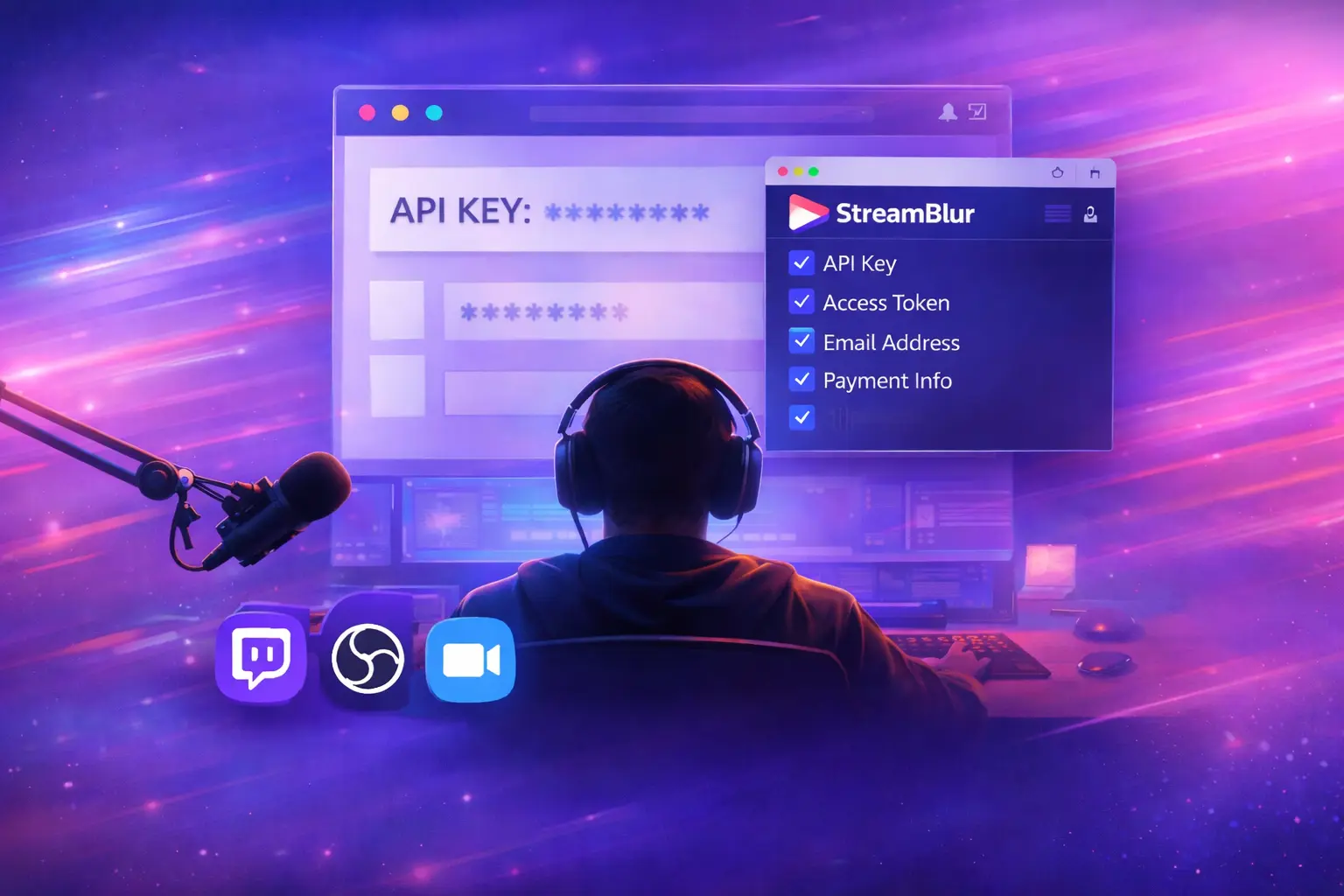
StreamBlur operates directly within the browser’s rendering layer rather than modifying backend data or requiring staging environments. The extension detects sensitive patterns such as:
- API keys and access tokens
- Email addresses and personal identifiers
- Payment references
- Internal system IDs
- Custom-defined keywords
When detected, StreamBlur applies real-time visual obfuscation before the content is clearly rendered on screen. This ensures that sensitive data remains functional within the system while being visually protected during streaming or screen sharing.
From a technical standpoint, this approach offers several advantages:
- No alteration of source data
- No dependency on external routing or proxy systems
- No disruption to platform functionality
- Protection that operates continuously during live sessions
For streamers, this means they can demonstrate real workflows without risking accidental data leaks. For SaaS companies, it reduces reliance on artificial demo environments and allows for authentic product walkthroughs with controlled exposure.
Presentation-Layer Security: A Structural Shift
Traditional privacy approaches fall into two categories:
- Data redaction before loading
- Post-production editing after recording
Both introduce friction, latency, and operational complexity.
Presentation-layer security treats the visual output itself as the control boundary. It acknowledges that the browser is the final surface visible to the audience and secures that surface in real time.
This model is particularly relevant for:
- Live SaaS product demos
- Revenue dashboard walkthroughs
- Investor presentations conducted via screen share
- Customer onboarding sessions
- Technical training streams
- Build-in-public workflows
As streaming becomes a revenue-generating activity, protecting on-screen information is no longer optional. It is foundational to maintaining trust and minimizing liability.
Streamer Privacy as a Competitive Advantage
From a brand perspective, visible operational discipline signals maturity. Audiences, clients, and investors notice when live sessions are controlled, structured, and free of accidental exposure.
Professional streaming in 2026 requires:
- Defined technical workflows
- Controlled screen environments
- Automated privacy safeguards
- Documented operational standards
Tools like StreamBlur represent a broader shift in the market toward preventative privacy controls rather than reactive damage control.
The most resilient creators and SaaS teams are not those who rely on perfect execution. They are those who engineer their environments so that minor lapses do not escalate into public incidents.
The Strategic Takeaway for 2026
If you stream live content, conduct SaaS demonstrations, or share production dashboards publicly, your privacy model must evolve.
Searcher intent around “secure live streaming,” “protect sensitive data on stream,” and “browser privacy for streamers” reflects a growing awareness that manual safeguards are insufficient.
In 2026, streamer privacy is no longer about avoiding embarrassment. It is about maintaining operational integrity, safeguarding proprietary information, and reinforcing professional credibility.
The shift is clear. Privacy is moving from habit to infrastructure.
And infrastructure, when designed correctly, becomes invisible, consistent, and reliable.
Leave a Reply